
ELECTION FRAUD NARRATIVES IN THE 2026 MIDTERMS
A Preliminary Analysis
The narratives shaping the 2026 midterm information ecosystem, where they’re spreading, and the communities most at risk.
Key Findings
Nativism undergirds contemporary claims of widespread election fraud, increasingly aligning election denial to explicit white supremacist frameworks and conspiracism.
01
Nearly 60 percent of over 1,600 posts analyzed made state-level claims, suggesting localized claims of fraud were favored among election deniers over national claims.
02
Two narrative clusters emerged: a voter eligibility cluster anchored by noncitizen voting claims and an election relitigation cluster led by claims referencing alleged widespread fraud in past elections.
03
Election denial narratives aim to normalize the disenfranchisement of racialized voters and voters perceived as foreign, codify restrictive nativist-driven election policies and delegitimize unfavorable results.
04

“At the nexus of the narratives outlined in this report, the defining deep narrative presents as unambiguous fearmongering about foreign or racialized outsiders conspiring to usurp political power and upend the country’s ‘founding principles.’”
The Gravitational Pull among top Narratives
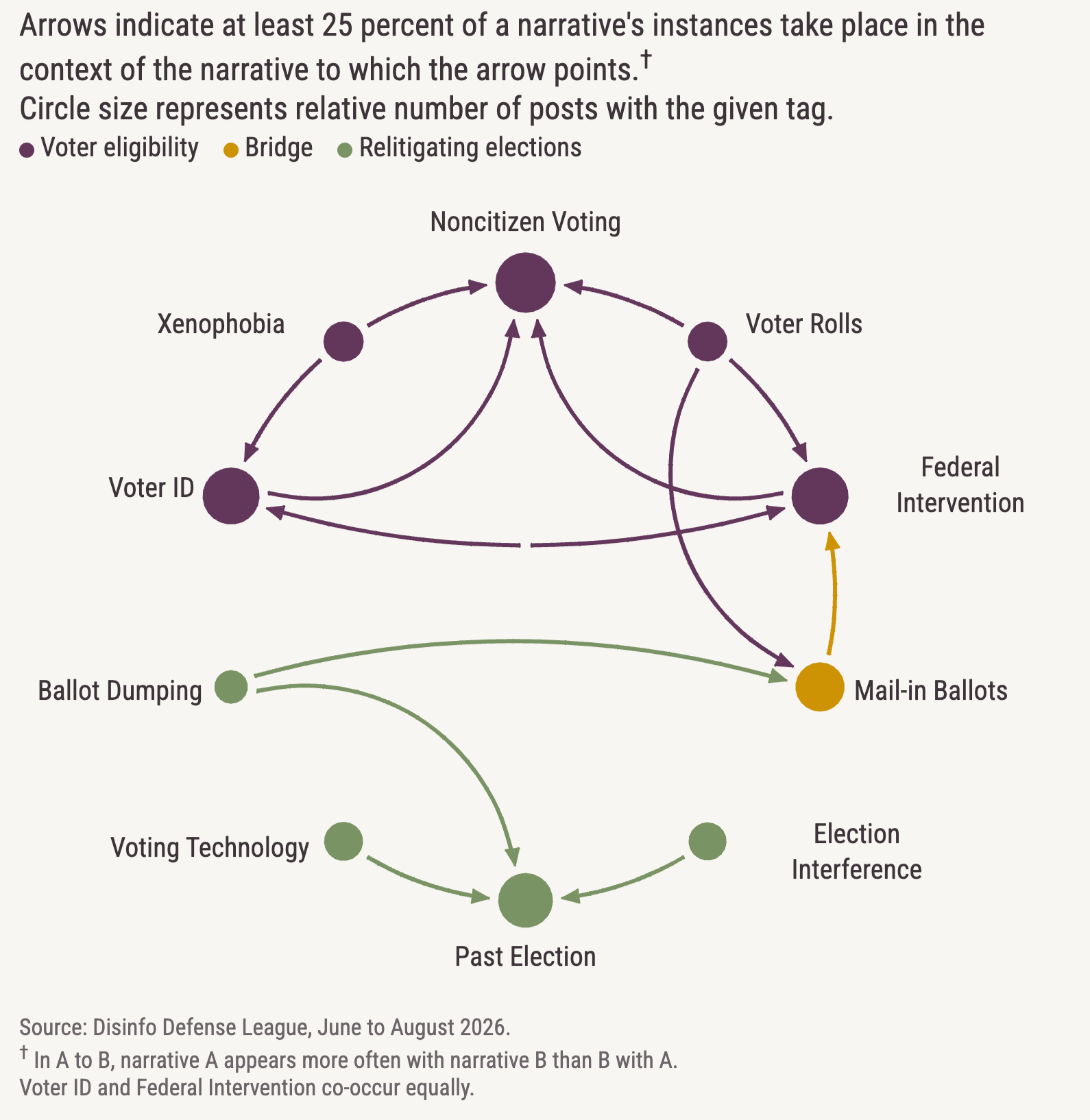
Researchers calculated a co-occurrence rate among narrative pairs to better understand the dynamics shaping election denial rhetoric.
Two clusters emerged during this analysis among the top 10 prevalent narratives captured in the dataset: a voter eligibility narrative cluster led by claims of noncitizen voters and an election relitigation narrative cluster led by content related to allegations of widespread fraud in prior elections.
Notably, the voter eligibility cluster diverged among claims centering voters’ religious, ethnic or immigrant backgrounds and claims scrutinizing the administration of voter rolls.

KEY RISKS HEADING INTO ELECTION DAY
Racialized voters are at risk of being profiled as noncitizens or as ineligible to vote and may face official or unofficial eligibility challenges before, during or after voting. Arab, Middle Eastern, Muslim and South Asian voters — especially those in Minnesota, Texas and Michigan — may be subject to heightened scrutiny when voting.

Battleground states with universal mail voting or no-excuse absentee voting are likely targets for claims casting doubt on security of these ballots. States with ballot deadlines after Election Day or that have generally later processing or counting start dates may face claims of ballot dumping and postmark date manipulation.
States that allow same-day registration may be vulnerable to claims of noncitizen voters and undercover operatives filming attempts to register at voting sites. States with non-documentary ID requirements may be subject to claims of inherent insecurity and attempts by undercover operatives to capture voter check-in processes.
Technological and logistical issues will likely be framed as suspect and amplified as evidence of election worker malfeasance or attempts to commit fraud. Anecdotal errors or malfeasance by election officials or poll workers will likely be amplified as evidence of mass fraud and may serve as pretext for federal intervention.
Expect on-the-ground influencers and operatives to deploy to voting sites, processing facilities, tabulation centers and post-election board meetings and certification hearings. Expect the amplification of digital perp walks by federal agency social media accounts to frame anecdotal instances of alleged noncitizen voters as evidence of widespread fraud.
Read the full report
If you found this report useful or want to get to know more about our work, get in touch.
© 2026 Disinfo Defense League. A project of Media Democracy Fund, strengthening democracy and shaping technologies that serve rather than extract from people and the planet.